TAS LECTURE | Reminder for Tue 27 October | Disaster Recovery: Unearthing the Impact of the Black Death in Eastern England

October 27 | Disaster Recovery: Unearthing the Impact of the Black Death in Eastern England Dr Carenza Lewis, University of Lincoln. 7.30pm at Stockton Central Library TS18 1TU. Guests are welcome for £4 each on the door.

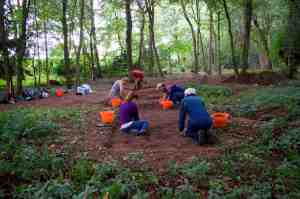
Since 2005, thousands of members of the public, working with university archaeologists, have carried out nearly 2,000 small archaeological ‘test pit’ excavationsCRL at Llandeilo in more than 50 rural villages, towns and hamlets in eastern England, unearthing tens of thousands of pottery sherds. Analysis of this superficially unremarkable material is allowing archaeologists to map and measure changes in layout and density of settlements over centuries, and has revealed new evidence for the dramatic long-term impact of the set-backs of the 14th century AD which culminated in the Black Death of 1348–9. One strength of this approach is that it can potentially be used anywhere, and the talk will conclude by considering the potential for similar work in areas such as the Tees Valley.

About the speaker

Since 2004, Carenza Lewis MA ScD FSA has been Director of Access Cambridge Archaeology at the University of Cambridge, having previously carried out archaeological research for RCH2007_0627_140044 cropME (1986–99) and the University of Birmingham (1992–4) and presented Channel 4’s Time Team (1993–2005). Carenza has completed fieldwork and excavation on many sites across southern England and her research interests include medieval rural settlements and landscapes, the archaeology of children and childhood, widening participation in higher education and public engagement with heritage research. Her work has involved thousands of members of the public and was recognised in 2008 with an honorary doctorate from UEA and, in 2009, when shortlisted for the Marsh Award for Public Archaeology. Carenza has recently joined the University of Lincoln as Professor of Public Understanding of Research

CHANGE TO TAS LECTURE | Tue 29 September | A talk on Community Archaeology with Rebecca Hearne

September 29 | Community Archaeology Rebecca Hearne, Community Archaeologist at AOC Archaeology Group7.30pm at Stockton Central Library TS18 1TU. Guests are welcome for £4 each on the door.

Unfortunately, Mitchell Pollington of AOC is unable to give this months lecture as scheduled. He sends his apologies, however we are delighted that his colleague, Rebecca Hearne, has agreed to stand in to give us a talk on community archaeology generally as well as an overview of some of the community projects that AOC have been carrying out.

About the speaker

Rebecca Hearne is a Community Archaeologist with AOC Archaeology GroRebeccaup in York. After graduating with an MGeol in Applied and Environmental Geology with the University of Leicester and an MSc in Archaeological Materials with the University of Sheffield, Rebecca worked as a community archaeologist with Portals to the Past and as a field archaeologist with ULAS (University of Leicester Archaeological Services).

TAS LECTURE | Reminder for Tue 30 June | The Archaeology of the A1 Dishforth to Barton Road Scheme

June 30 |The Archaeology of the A1 Dishforth to Barton Road Scheme Dr Stephen Sherlock, A1 Archaeology Clerk of Works7.30pm at Stockton Central Library TS18 1TU. Guests are welcome for £4 each on the door.

Steve’s lecture will present the archaeological results from the improvements to the A1 road through North Yorkshire, undertaken on behalf of the Highways Agency between 2009 and 2015. The size of the project—a total length of 24 miles—meant the project was split into two phases, the main site to be excavated during the work in 2009–2010 was the Roman vicus at Healam Beck.Catterick

The second programme of work commenced in late 2013 and there has been a broader range of sites—and a substantial increase in the number of artefacts. The sites range from an Early Mesolithic settlement at Little Holtby with over 4,000 flint tools found in 2014, to a burial mound of probable Bronze Age date south of Catterick. The main focus of the excavations is around Catterick, with both Iron Age settlement to the north and Iron Age burials to the south of the Roman fort and town.

The main discoveries have been around Catterick where there are two scheduled ancient monuments. Here there are traces of a Roman cemetery, fields, and metalworking around Bainesse. At Cataractonium, Dere Street has been exposed near the River Swale with Roman buildings alongside and evidence for the town defences near the river itself. The lecture will outline the work at Healam, the approaches to discovering the sites, and present the most up to date interpretations of discoveries around Catterick—although fieldwork and post-excavation analysis will be continuing through 2015.

About the speaker

Steve Sherlock has been a professional archaeologist for 35 years and has spent much of that time working in North-east England and as a TAS member. Whilst much of his research has been focused on East Cleveland, he has undertaken major excavations on Iron Age and Anglo-Saxon sites in the region.steve

Commercially, he has also excavated and published on later sites such as the medieval settlements at Castleton and Long Marston. He has been the archaeological clerk of works, working on the A1 road improvements in North Yorkshire, as well as other projects in the area. His work is published in regional journals, conference proceedings and in two Tees Archaeology monographs (2012).

TAS LECTURE | Reminder for Tue 26 May | Early Medieval Perceptions of the Past: Identity and the Prehistoric in Anglo-Saxon England

May 26 | Early Medieval Perceptions of the Past: Identity and the Prehistoric in Anglo-Saxon England | Dr Sarah Semple, Durham University. 7.30pm at Stockton Central Library TS18 1TU. Guests are welcome for £4 each on the door.

The prehistoric and Roman inhabitants of England left a rich repertoire of monuments and remains. In the post Roman aftermath, the communities that struggled to redefine themselves and their control over landscape and resources, began to creatively draw upon these physical and material legacies. The natural landscape exerted a pFigure 6.10rofound shaping effect on territory, the legacy of the prehistoric and Roman past. Barrows, enclosures, forts—as well as Roman and Romano-British places and remains—proved key to the flourishing of new communities, and the ancient and more recent monuments in the landscape were drawn upon in the creation of new stories of origins, power and descent. This presentation explores how these processes helped shape the local world view of communities and how, by the 6th and 7th centuries, emerging elite and royal power began to exploit and harness ancient monuments and the landscape for their own, new ambitious vision of power.

About the speaker

Sarah’s research focuses on the early medieval period in Britain and Northern Europe. She is especially interested in understanding early medieval interaction with the natural and man-made environment with particular reference to the role of landscape in definitions of identity, religion and cult practice, as well as charting the ideological and political uses of natural topography and ancient remains.

Figure 3.3Recent publications include: Anglo-Saxon Perceptions of the Prehistoric. Ritual, Religion and Rulership (2013) and Signals of Belief in Anglo-saxon England (2010). She recently completed a collaborative project exploring the important monastic sites of Wearmouth and Jarrow. Further regional involvements include field investigation at Yeavering, Northumberland, Sockburn, County Durham and at Etal on the Northumberland border.

TAS LECTURE | Reminder for Tue 21 April | The Creation of an Estate: Archaeological Investigations at Kiplin Hall, North Yorkshire

April 21 |The Creation of an Estate: Archaeological Investigations at Kiplin Hall, North Yorkshire | Jim Brightman, Solstice Heritage 7.30pm at Stockton Central Library TS18 1TU. Guests are welcome for £4 each on the door.

The ‘Charting Chipeling’ project was a volunteer archaeology project, funded by the Heritage Lottery Fund, and focusing cDSC_0786on the Jacobean and later Kiplin Hall and its grounds, located near Richmond, North Yorkshire. Set within a wider landscape of prehistoric and Roman archaeological sites, the wide sand and gravel terraces flanking the River Swale are known to host archaeological remains ranging from the Mesolithic to the present day and, prior to the building of the Hall, Kiplin was dominated by a monastic grange of the nearby Easby Abbey. Despite this, the Kiplin grounds have been subject to almost no previous archaeological investigation. What has emerged is a fascinating story of the development of the grounds as we see them today, a dynamic period of change and remodelling of the land against a backdrop of societal and industrial reform.

About the speaker

Jim Brightman, Director of Solstice Heritage, is a professional archaeologist and heritage consultant with over a decade of experience in undertaking and supervising planning-led archaeology, research and conservation, and community-based projects. Jim’s wide-ranging experience has included working on urban and rural sites of all kinds, and examining archaeological remains from Mesolithic hunter-gatherers to late Victorian slum housing.

In the early 2000s Jim completed a BA and MLitt in archaeology at Newcastle University during which he developed his passion for the archaeology of northern England which had been first kindled by the castles and abbeys of North Yorkshire as a child. Outside archaeology Jim is a keen musician and hillwalker, and can also be found dangling from rock faces around the north of England. Jim is a fully accredited member of the Chartered Institute for Archaeologists (MCIfA).

TAS LECTURE | Reminder for Tue 31 March | Crowd-funding and Crowd-sourcing in Today’s Archaeology: Lisa Westcott Wilkins & Brendon Wilkins

March 31 | How Far from the Madding Crowd? Crowd-funding and Crowd-sourcing in Today’s Archaeology | ,DigVentures 7.30pm at Stockton Central Library TS18 1TU. Guests are welcome for £4 each on the door.

Numerous community archaeology projects are undertaken every year in the UK on a wide range of sites by a variety of public, private and third sector organisations. Building on this provision, a new social, digital and collaborative economy is also emerging, creating an access step-change that has made it radically easier for communities to form. The emerging field of digital public archaeology has struggled to adequately theorise these new developments, assuming that all community archaeology projects can be simplified into one of two overarching methodological orientations: ‘top down’ or ‘bottom up’. In the former, projects can be conceived as a stage-managed collaboration between expert and public, with the expert retaining control over design, fieldwork and analysis. In the latter, the agenda is set according to the needs of communities themselves, with the expert relinquishing control of the process into the hands of non-professionals.

Drawing on our ‘Digital Dig Team’ innovation, this presentation will consider new approaches that enable archaeologists to co-fund, co-design, co-deliver and co-create value with their respective communities—innovations that make no sense in terms of top down or bottom up, and demand a rethink of community-based models that rely on economic theory. The digital and collaborative economy is more akin to an ecological system, where socially embedded technologies (often bracketed under the term ‘citizen science’) present archaeologists with a multitude of opportunities to do things radically differently. They open new vistas for archaeological knowledge creation, ultimately realising the value of research through a truly social method.

ABOUT THE SPEAKERS

TAS

Lisa is Managing Director and Brendon is Projects Director at DigVentures, a social business at the forefront of culture, technology and entrepreneurship, committed to raising seed capital and increasing participation for sustainable archaeology and heritage projects worldwide.
Their innovative model works to connect heritage sector managers and archaeologists with a worldwide crowd of interested and actively engaged participants, creating a platform for the public to financially support interesting projects as well as to join in, learn new skills and contribute to internationally important research. As a Chartered Institute for Archaeologists Registered Organisation (RO) and the first-ever CIfA Accredited Field School, their work and opportunities are quality-assured at the top of the industry standard.
Over the last two years DigVentures has raised over £65K in seed funding from a globally networked crowd of supporters—money that has gone on to leverage four times that amount for their project partners in match funding.

TAS LECTURE | Reminder for Tue 24 Feb | Roman Binchester: Dr David Petts

DSCF7440

February 24 | Roman Binchester: Barracks, Bath-houses and Belief at a Roman Fort | Dr David Petts, Durham University 7.30pm at Stockton Central Library TS18 1TU. Guests are welcome for £4 each on the door.

Members will be able to collect the TAS Bulletin journal 19 (2014-15), Membership cards and 2015 Programme cards. If you are paying or renewing a subscription, please complete a Membership Form.

FINDS HANDLING!


BinchestergodRecent excavations at Binchester have revealed unexpectedly good preservation of the underlying archaeology. This lecture will provide a chance to hear about the range of exciting discoveries made during the 2014 season of work at the site.

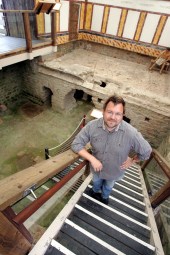
The most spectacular developments have been the uncovering of one of the best preserved Roman bath-houses in northern Britain. Standing in places over 2m high, this structure is one of the highlights of the project. However, exciting progress has been made elsewhere including unpicking the complex remains of a Roman cavalry barrack, and its associated latrine block, and the exploration of structures dating to the very final years of the Roman presence in Britain. Finally, this lecture will explore the increasing evidence we’ve found about the religious belief and ritual activities of the population of Roman Binchester, including a discussion of a rare early Christian ring found at the site.

ac250609arc5About the speaker

David Petts is a Lecturer of Archaeology at Durham University and has been leading the Binchester project since 2009. He is a specialist in early Christianity in Britain with a particular enthusiasm for early medieval monasticism, and is currently in the early stages of developing a research project to explore the archaeology of Holy Island (Lindisfarne).

See you there!

Explore the 2015 TAS Lecture Programme »

TAS BULLETIN 19: 2014-15 Availability | Online & Print

Dear TAS Members,
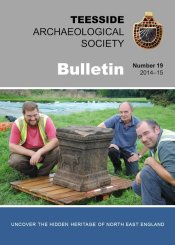
TAS_Bulletin_19_2014_CvrThe BULLETIN is our annual journal provided exclusively to members since 1994. It covers the latest fieldwork activity and discoveries in the Tees Valley, Cleveland and broader region. We’re delighted to announce availability of Number 19: 2014-15.
  • You can browse and download the BULLETIN now as a PDF file (11 Mb)
  • Printed copies will be available for 2014 and 2015 members at the next lecture, Tue 24 Feb, and will be posted in March if you’re not able to collect
  • Many back copies are available to download and a very limited supply of paper editions is available to purchase at TAS BOOKSTALL at the end of lectures
The PDF downloadable files are  password protected and available only to 2014 and 2015 subscribed members. Email teesarchsoc.news@gmail.com with subject “Bulletin pw” for the password – please include your full subscribed name. When you click the link it may take a minute for the file to load. You will then be prompted for the password. You can view the file in your browser or download it to your computer. Paper back-copies are also available via The British Library inter-library loan.

Contents | A4 68pp + 4pp covers
Proceedings
Editorial | Maureen Norrie
Chair’s Year in Review | Spencer D Carter
Articles                                                                                                                                                                                          
Development-led Archaeology in County Durham and Darlington 2013–14: an update from the Durham County Council Archaeology Team | Clare Henderson
Darlington Town Hall 2013 Excavations | Matthew Claydon
Roman Binchester 2014: another successful season | David Petts
A Visit to Durham University Museum of Archaeology with Gemma Lewis, Deputy Curator of Durham Castle and Archaeological Collections | Maureen Norrie
Tees Heritage Protection Alliance: our past for the future | Dan Maddison
Back Garden Excavations: digging in Brotton, Redcar & Cleveland | Michael Roe
Reprise – e-news reprints for members without Internet access
You, Me and Dmanisi: the exciting and complicated world of human evolution | David Mennear
Education Before History: a National Curriculum revolution | Kim Biddulph
Intertidal Prehistoric Peat Beds at Redcar, North-east England: axe marks the spot? | Spencer D Carter
Reviews
Book Review | The Human Past: world prehistory and the development of human societies | 3rd edition 2013
From the Archives
And Finally…
Programme
TAS 2015 Programme | abstracts, images and speaker biographies

Kind Regards,Spence
Spencer Carter | TAS Chair & eCommunications

TAS HAPPY NEW YEAR | Membership Reminder and News Update

Dear TAS Members and Friends,

HAPPY TAS NEW YEAR!

On behalf of the TEESSIDE Archaeological Society Committee, I hope you all had a warm and relaxing Christmas break. Last year was a great one for TAS — the lecture programme with a bonus slot and many finds-handling opportunities, increasing membership, the CSI forensics event by TAS Secretary Dave Errickson at Teesside University, a heritage planning process workshop in Durham with our friends at AASDN (the “Arch and Archs” of Durham & Northumberland) and CBA North, plus the many fantastic discoveries around our region.


TAS MembershipNow is the time to renew your membership, or join TAS for an eventful 2015. Please download the 2015 Membership Application Form and either post it with a cheque or postal order — note the new address on the form — or bring it along to the AGM on Tuesday 27 January at 7pm (half an hour earlier than usual to give us plenty of time) at Stockton Central Library. Check our website for directions to the library if this will be your first visit. We look forward to seeing you!

IMPORTANT | We can only receive subscriptions with a completed application form. Cheques will be processed after the AGM. And sorry folks: payment by BACs, Paypal or Credit/Debit Card is not currently possible due to high transaction fees and security issues.

Ahead of the AGM we’ll be posting the agenda to all 2014 and 2015 members and hopefully we’ll have the 2015 Programme ready too (see below). 2015 Membership Cards will be distributed at the February lecture and by post if you can’t collect.


TAS 2015 PROGRAMME TASTER! Dates for your diary

All lectures begin at 7.30pm unless stated otherwise. Lecture titles are not yet finalised.

Tue 27 Jan 7.00pm for 7.30 | TAS AGM and Members’ Evening | Lecture: Dr Tim Thompson, Teesside University, “CSI Forensics” | SPECIAL FEATURE! The infamous TAS Christmas Cake courtesy of Mrs Carter senior
Tue 24 Feb | Dr David Petts, Durham University, “Roman Binchester Bling”
Tue 31 Mar | Lisa Westcott Wilkins & Brendon Wilkins, DigVentures, “Crowd-funded Archaeology”
Tue 21 Apr | Jim Brightman, Solstice Heritage, “Archaeology at Kiplin Hall” *NOT the last Tue due to UK Elections*
Tue 26 May | Dr Sarah Semple, Durham University, “Saxon Landscapes”
Tue 30 Jun | BONUS LECTURE! Dr Steve Sherlock, “A1 Archaeology Update”
SUMMER BREAK | FESTIVAL OF ARCHAEOLOGY 11-26 July
Tue 29 Sep | Mitchell Pollington, AOC Archaeology Group, “Digging for Money – Commercial Archaeology”
Tue 27 Oct | Dr Carenza “TimeTeam” Lewis, Cambridge University, “Community Archaeology”
Tue 24 Nov | Phil Abramson & Steve Sherlock, “Operation Nightingale Catterick & Cyprus”
Sat 05 Dec 10am Dorman Museum | ELGEE MEMORIAL LECTURE Prof Colin Haselgrove, Leicester University, “Iron Age Royal Centre at Stanwick”


TAS MEMBERSHIP VALUE

Maureen Norrie, TAS Editor, and I are working on what looks like a truly bumper TAS BULLETIN, our annual journal for members. All being well, Number 19 (2014) should be available for collection at the AGM, otherwise we’ll post copies to 2014 and 2015 members. It will also be available as a password-protected downloadable version, as are our digitised back copies.

Similarly, the 2015 Lecture Programme is complete — again with a bonus lecture in June — and a number of hands-on finds handling opportunities. We’re just waiting for a few abstracts and pictures from the presenters before we get it printed and updated on our website and Facebook page. There will also be a lecture at the AGM after a rapid review of the year, our prospects and Committee elections.

On that note, we’re looking for a new TAS Treasurer to join the Committee since the incredible Mick Butler has been in the post for very many years now and travels around the globe a great deal with his work. Our finances are in good shape with the increase in membership through 2014. If you’re interested, and without a Treasurer we cannot operate, please email us at teesarchsoc.news@gmail.com

Remember  —  your membership is a commitment to our ongoing success as a community that cares passionately about our shared heritage, archaeology, advocacy and learning. Your subscription pays for the lecture venue, speakers’ travel, our public liability insurance and insurance for fieldwork, printing costs, postal mailing and the fantastic BULLETIN journal. TAS VALUE!


TAS BOOKSTALL

In November last year we re-launched the TAS BOOKSTALL thanks to help from new Committee Member Guy Forster, and your Chair donated a shed-load of Roman books with many more to come in January — all available to TAS members at bargain prices. There are a few collectors’ items in the boxes too! BOOKSTALL will be a feature at the end of each lecture, so why not peruse, pick up a bargain, or donate books you’ve already read?

ARCHAEOLOGY
MATTERS!


TAS is proud to be an affiliate member of the Council for British Archaeology at a national level and also of the CBA North and CBA Yorkshire regions. Many of you will know about the vital work of the CBA over the last 70 years — lobbying, campaigning, training and advocating for our archaeology and heritage.

Click to download as a PDF.

To ensure the CBA has the resources to respond to the significant challenges now facing archaeology — despite it’s proven value to GDP, the economy, well-being and communities — they are running an appeal to raise an additional £250,000 each year for the next three years to support their important work

By investing in the future of the CBA now — as a member, donor friend, ambassador or lifetime member — you can help to provide a stable foundation so that they can continue to resource their vital campaigning and advocacy work, projects and programmes. With unprecedented cuts to the sector, ARCHAEOLOGY MATTERS more than ever, and for future generations too.

Together we can help to give future generations the opportunity for a lifetime of involvement in archaeology. Read more about the ARCHAEOLOGY MATTERS appeal and how you can contribute.


Lastly, I would like to offer personal thanks to all the TAS Committee members for outstanding help, ideas and legwork through 2014 — those new to, remaining on or standing down* from the Committee, and all generous with their own time as volunteers:

  • David Errickson, Secretary (integrating Membership role in 2015)
  • Mick Butler, Treasurer* (remains in post until new Treasurer is appointed)
  • Carole Tyson, Lecture Readiness & Hospitality
  • Maureen Norrie, Editor
  • Bruce Webb-Ireland, Fieldwork & Events
  • Edward Higgins, Membership Secretary*
  • Guy Forster, Bookstall
  • Robin Daniels, Tees Archaeology Liaison & River Tees Rediscovered HLF Landscape Partnership Project (ex officio)

Kind Regards,

Spence

Spencer Carter | TAS Chair & eCommunications

Feel free to forward our e-Newsletter to friends and contacts using the forward to a friend feature at the end of the message—they will be able to subscribe securely. To unsubscribe, unsubscribe or change your contact preferences, use the links or email us.
The Committee welcomes your feedback,
questions, suggestions and news.
UNCOVER THE HIDDEN HERITAGE OF NORTH EAST ENGLAND

TAS DIARY | Lecture: Roman Roads in North Yorkshire – The Enigmatic Tees Crossing | Sat 13 Dec

Tees

Dear TAS Members and Friends,

John Brown, an Independent Researcher and Field Archaeologist, will give the fourth in a series of talks on The Roman Roads of North Yorkshire at Thornton le Street Village Hall between Thirsk and Northallerton on Saturday 13 December 2014 at 2.00 pm. Admission will be £2 at the door. This programme is designed to both report on recent activity and to encourage future research within a professional framework.

About the Lecture


John is Manager of the Mid-Tees Research Project which was founded with the purpose of locating and investigating Roman and early medieval archaeology in the Tees Valley. The present focus is a multi-period site covering an area of approximately 1 square km at Sockburn on the River Tees, which is the postulated Tees crossing of Cades Road (Margary 80a), and has been known as a crossing point of the Tees from early times.

Image | © 2014 Getmapping Plc.

Cade’s Road is named after John Cade of Durham, an 18th-century antiquarian who in 1785 proposed its existence and possible course from the Humber Estuary northwards to the River Tyne, a distance of about 100 miles (160 km). Although evidence exists for such a road on some parts of the proposed route, particularly through North Yorkshire, there is still some doubt regarding its exact course and where it crossed the Tees. The road’s Roman name is unknown, although Cade referred to it as a continuation of Rycknild Street.

The road began at Brough-on-Humber where there was a ferry, a Roman fort and civilian settlement (Petuaria) alongside a major Celtic settlement. It is suggested that it ran northwards through Thorpe le Street and Market Weighton, before gradually turning westwards (possibly following the line of another Roman road) until it reached York (Eboracum). From York it continued northwards to Thornton-le-Street and on to cross the River Tees. It is then assumed to pass through Sadberge and east of Durham City on its way to the Tyne.

An alternative crossing has been suggested between Middleton St George and Middleton One Row, where it is suggested that ‘Pounteys Lane’ is named after a Roman bridge (Bridge of Tees). Indeed bridge remains, and Roman artefacts, have been found there in recent times. This accords with the generally accepted course of the road through North Yorkshire which requires a crossing at this point. John will illustrate his work at Sockburn and his claim that the current evidence shows this crossing to be the more likely.

More Info | Further details can be obtained from John Sheehan: Telephone 01609 771878 or email jgsheehan@btinternet.com

Kind Regards,

Spencer Carter | TAS Chair & eCommunications