31st May | Community Archaeology: Getting Involved with Research | Dr Jon Kenny, Independent Community Archaeologist. 7.30pm at Stockton Central Library TS18 1TU. Guests are welcome for £4 each on the door.
At a time when a great deal of archaeological activity is decided upon by the interests of developers and planners less opportunity seems available for research with the hope of discovery. As some archaeological societies and local archaeology groups are finding there 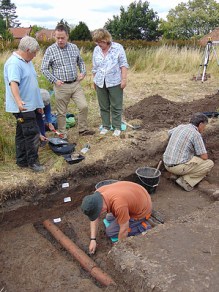 are opportunities for volunteer led archaeology to make discoveries about the past. In this talk I would like to present results of two projects from the Vale of York, south of York at Cawood and North Duffield. In both instances local history and archaeology groups have obtained funding to carry out excavations, answering questions that they have about the past in their historic landscape. In both instances the work was supported by the Heritage Lottery Fund.
are opportunities for volunteer led archaeology to make discoveries about the past. In this talk I would like to present results of two projects from the Vale of York, south of York at Cawood and North Duffield. In both instances local history and archaeology groups have obtained funding to carry out excavations, answering questions that they have about the past in their historic landscape. In both instances the work was supported by the Heritage Lottery Fund.In this talk Jon will outline work carried out on the Iron Age landscape around North Duffield situated on the western margins of the river Derwent. At North Duffield evidence for Iron Age enclosures and settlement were revealed. The latter was represented by an unexpectedly large round house. At the second site at Cawood, some 10 miles away on the west bank of the river Ouse, Jon will tell us about a project, evaluating the deposits on a moated manorial centre located alongside the Arch Bishop’s palace. In both cases the community teams have successfully completed archaeological projects. But as part of the community they have found exciting and interesting ways to involve as much of the community as possible. The result of their work is not only a better understanding of the past around them but also inclusion in the management of the historic environment where they live.

About the Speaker
Jon Kenny is an independent community archaeologist working  in Yorkshire based in and around York. He worked in local government housing until going to study archaeology at the University of York where he obtained a degree and a Masters in Archaeological Heritage Management. Jon completed his academic career by obtaining a doctorate at Lancaster University in 2001. Following time working as a project manager with the Archaeology Data Service at the University of York he became Community Archaeologist at York Archaeological Trust. At YAT Jon was involved with many community projects supporting local groups and involving people from all walks of life in different aspects of archaeology. Jon was also instrumental in ensuring that a volunteer team was involved with the multi million pound excavation at Hungate in central York. After 9 years with YAT Jon set up his own business, continuing to make archaeology accessible to all. In November 2015 Jon was awarded the prize as Community Archaeologist of the Year by the CBA and Marsh Christian Trust. It was Jon’s work with North Duffield and Cawood in particular that led to this award.
in Yorkshire based in and around York. He worked in local government housing until going to study archaeology at the University of York where he obtained a degree and a Masters in Archaeological Heritage Management. Jon completed his academic career by obtaining a doctorate at Lancaster University in 2001. Following time working as a project manager with the Archaeology Data Service at the University of York he became Community Archaeologist at York Archaeological Trust. At YAT Jon was involved with many community projects supporting local groups and involving people from all walks of life in different aspects of archaeology. Jon was also instrumental in ensuring that a volunteer team was involved with the multi million pound excavation at Hungate in central York. After 9 years with YAT Jon set up his own business, continuing to make archaeology accessible to all. In November 2015 Jon was awarded the prize as Community Archaeologist of the Year by the CBA and Marsh Christian Trust. It was Jon’s work with North Duffield and Cawood in particular that led to this award.Website: www.jkcomarc.co.uk
 in 1979 with a BSc in Archaeological Conservation. He carried out his doctoral research on the composition and manufacturing technology of medieval copper alloy pins at the University of Bradford and was awarded a PhD in 1986. Between 1984 and 1988 he was the artefacts conservator at the York Castle Museum. In 1988 he became lecturer in Archaeological Conservation and Archaeological Science at the Dept. of Archaeology, University of Durham, becoming a senior lecturer in 1996. He has He has been a Fellow of the Society of Antiquaries (FSA) since 2002.

 growing interest in archaeology led him to undertake doctoral work in the Research Laboratory for Archaeology at Oxford. In 1995 he took up a position as lecturer at Durham University where his research has broadened to cover the chemistry of bones and teeth applied to archaeological problems, and Bayesian statistics applied to archaeology, particularly to the analysis of scientific dating techniques, and with wider applications in Quaternary science.


 roles, including Sunderland Museum and Winter Gardens, Discovery Museum, and Great North Museum: Hancock where she developed a passion in Roman archaeology. Lauren planned and delivered Roman based projects funded by the British Museum, as well as delivering many workshops, talks and tours for children and adults before being appointed to her current role at Vindolanda. In this lecture she will be bringing us up to date with the latest developments at this fascinating site.
 Leicester since 2005. Between 1977 and 2004, he taught in the Archaeology department at Durham University where he was made a Professor in 1995. His research focuses on the British and European Iron Age, on the Iron Age to Roman transition in north-west Europe, and on early coinage and currencies. Colin is a Fellow of the British Academy and of the Societies of Antiquaries of London and Scotland. He was Head of the School of Archaeology and Ancient History at Leicester from 2006–12.
 rank Elgee was born in 1880 in North Ormesby and was curator at the Dorman Museum from 1904 to 1944.The memorial lectures have run annually since 1968, hosted in turn by the archaeological, historical and natural history societies of Teesside. The 2015 lecture is hosted by the Teesside Archaeological Society.


 Teesside Archaeological Society